

Meet the Megalodon: Earth’s Mightiest Shark
Millions of years before humans walked the Earth, a monstrous predator patrolled the oceans. The megalodon, scientifically known as Carcharocles megalodon, was the largest shark ever to exist, with estimates suggesting it reached nearly 60 feet long and weighed up to 50 tons. Some researchers argue it could have grown even larger, possibly exceeding 80 feet, dwarfing every modern shark.
For comparison, a modern great white shark would have measured about the length of a megalodon’s genitals, according to shark expert Peter Klimley. Everything about the creature was extreme, its size, its strength, and its speed.
Despite being so huge, the megalodon was remarkably swift. It could swim at speeds up to 16.5 feet per second, nearly twice as fast as today’s fastest sharks. That combination of size and agility made it the absolute apex predator of the ancient seas.
Yet this gigantic creature disappeared 3.6 million years ago, leaving behind more questions than answers.
The Megalodon’s Monster Bite
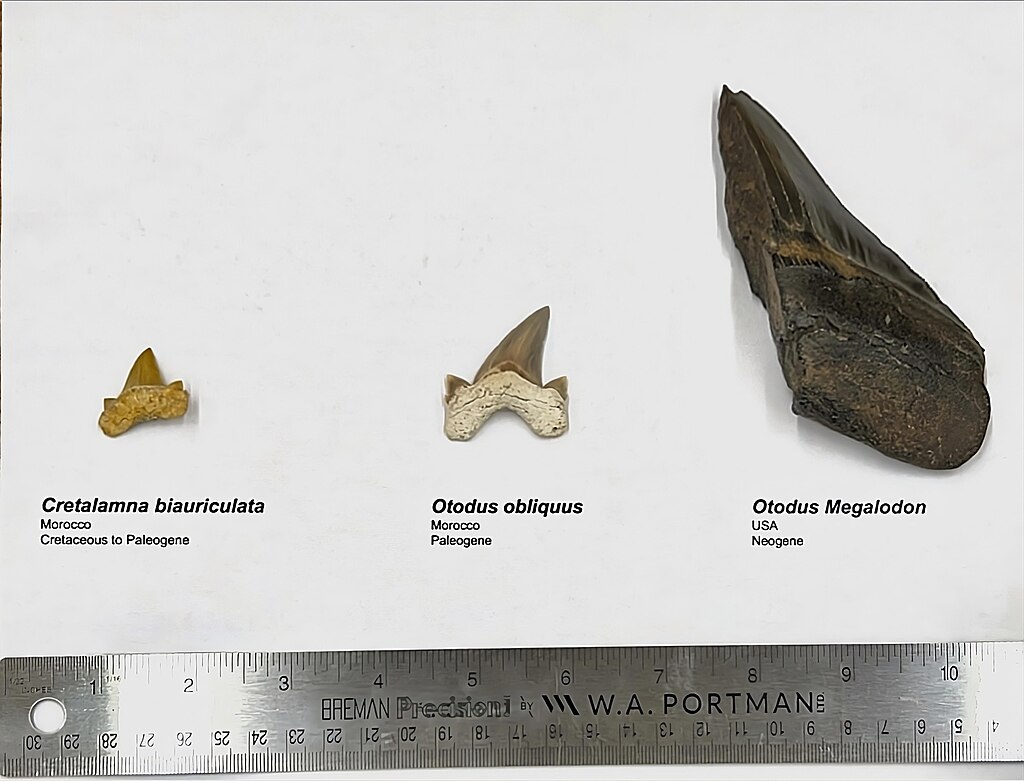
Much of what scientists know about the megalodon comes from its teeth. Sharks don’t have bones, their skeletons are made of cartilage, so teeth are often the only remains that endure long enough to fossilize. And the megalodon’s teeth are unmistakable.
The name “megalodon” literally translates to “big tooth” in Greek. The largest recovered tooth measures over seven inches, while most fall between three and five inches, still larger than a great white’s largest teeth.
These teeth were:
- triangular
- serrated
- perfectly designed for slicing through flesh
- arranged in powerful, replaceable rows
Like all sharks, megalodons constantly shed their teeth. Experts estimate they cycled through 20,000 to 40,000 teeth in a lifetime.
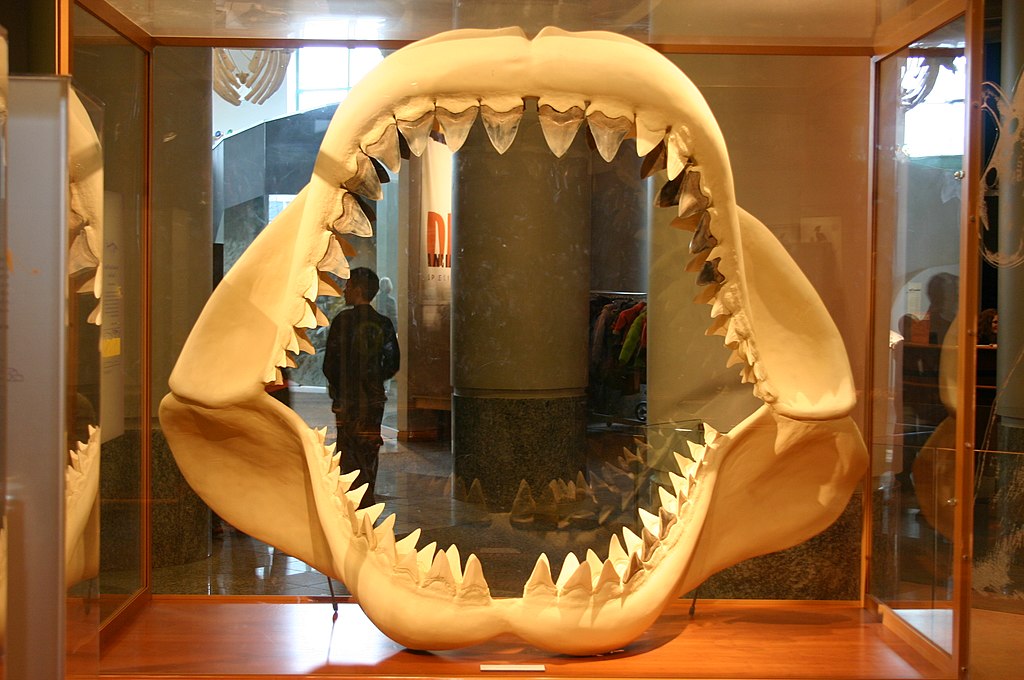
But the teeth are only part of the story. The megalodon’s jaw, reconstructed from fossil evidence, measured up to 9 feet tall and 11 feet wide, capable of swallowing two adult humans side-by-side.
Its bite force was even more terrifying. Humans bite down with a force of roughly 1,300 Newtons. The megalodon’s bite force ranged from 108,000 to 182,000 Newtons, powerful enough, scientists say, to crush an automobile.
And it needed that force, because its prey included some of the largest creatures on Earth.
How the Megalodon Hunted: A Killer That Ate Whales
Fossil records show megalodon teeth scattered across almost every continent except Antarctica, meaning the shark’s range extended throughout most of the prehistoric oceans. It preferred warm, shallow waters, which were abundant during its reign.
But being gigantic came with one major challenge: constant hunger.
To survive, megalodons routinely hunted large marine mammals such as:
- early baleen whales
- humpback-like whale species
- dolphins
- seals
Some fossilized whale bones even show bite marks that match megalodon teeth, evidence of brutal attacks.
Researchers believe megalodons often hunted strategically. Instead of immediately killing their prey, they targeted whale flippers or tails first, crippling the animal and making it easier to consume. Few predators in history have demonstrated such methodical violence.
Adult megalodons were so large that nothing preyed on them. Only juveniles, around seven feet long at birth, were vulnerable, occasionally falling victim to larger sharks like hammerheads seeking to eliminate competition early.
For millions of years, the megalodon reigned supreme. So why did it suddenly vanish?
The Mysterious Extinction of the Megalodon
Roughly 3.6 million years ago, the megalodon disappeared entirely from the fossil record. The cause remains one of marine science’s biggest mysteries, but researchers have proposed several possible explanations.
Cooling Oceans and Shifting Habitats
Around the time megalodons went extinct, Earth entered a major cooling phase. Global temperatures dropped, reshaping the oceans. Species that preferred warm waters, including many of the megalodon’s prey, moved into colder regions the giant shark could not tolerate.
As whales adapted to cooler seas, megalodons were left behind.
Rapid Decline in Prey Species
Up to one-third of all large marine animals died during this cooling period, collapsing parts of the food chain. Marine paleontologist Dana Ehret told National Geographic that megalodons depended heavily on whales for food:
“You see a peak in whale diversity in the mid-Miocene when megalodon shows up in the fossil record, and this decline in diversity in the early-middle Pliocene when meg goes extinct.”
Without enough whale populations to sustain them, megalodons, and their massive caloric needs, may have starved.
Competition From Great Whites
Great white sharks began to spread during the same period. Unlike megalodons, great whites tolerated cooler waters and could access prey the megalodon no longer could. As food scarcity increased, competition intensified, and smaller, faster, more adaptable sharks sometimes win in evolutionary battles.
A Combination of Forces
Most experts believe megalodons were overwhelmed by a combination of factors:
- changing temperatures
- diminished prey
- increased competition
- shrinking habitats
In the end, even the ocean’s most fearsome predator could not escape extinction.
Could the Megalodon Still Be Alive? Scientists Say No.
Movies like The Meg and sensational TV mockumentaries have fueled conspiracy theories that megalodons still lurk in the deep ocean, far beyond human detection.
While it’s a fun idea, scientists overwhelmingly agree the megalodon is extinct. And the reasons are straightforward:
1. No modern teeth have ever been found
If megalodons were alive, they would still shed tens of thousands of teeth, none have appeared.
2. No whales bear massive bite marks
Whales today show scars from orcas, sharks, and collisions, but nothing resembling megalodon-level damage.
3. Modern oceans are too cold and too deep
A living megalodon would need warm, shallow waters similar to ancient Earth’s oceans, environments that no longer exist in the same way.
Shark researcher Greg Skomal told Smithsonian Magazine:
“We’ve spent enough time fishing the world’s oceans to have a sense of what’s there and what’s not.”
Even if a distant cousin of the megalodon survived, experts say its size, diet, and physiology would be dramatically different.
As Hans Sues of the Smithsonian put it:
“They wouldn’t even think twice about eating us. Or they would think we are too small.”
But paleobiologist Catalina Pimiento countered with a darkly humorous twist:
“We’re not fatty enough.”
Modern Discoveries: What New Megalodon Teeth Are Teaching Us
Despite going extinct millions of years ago, megalodons continue to captivate scientists and fossil hunters alike. Because sharks shed teeth constantly, new fossils appear every year, sometimes in extraordinary ways.
In December 2022, nine-year-old Molly Sampson and her sister Natalie were hunting for shark teeth in Maryland’s Chesapeake Bay. Wearing brand-new waders, Molly ventured deeper than usual, and spotted something enormous.
“I went closer, and in my head, I was like, ‘Oh, my, that is the biggest tooth I’ve ever seen!’” she said. “I reached in and grabbed it, and dad said I was shrieking.”
The tooth she found was so large that Stephen Godfrey, curator of paleontology at the Calvert Marine Museum, called it:
“A once-in-a-lifetime kind of find… one of the larger ones that’s probably ever been found along Calvert Cliffs.”
These kinds of discoveries excite researchers, not just collectors. Each new fossil helps scientists refine:
- megalodon growth patterns
- hunting behaviors
- body proportions
- how fast they swam
- how they interacted with early whales
Recent modeling suggests megalodons could consume prey the size of modern killer whales in just a few bites, reinforcing their status as one of Earth’s most powerful predators.
A Creature Best Left to the Past
The megalodon remains one of the most awe-inspiring animals to have ever lived. Its enormous size, incredible speed, and unmatched bite force made it the undisputed ruler of ancient seas. And while its extinction remains partially mysterious, scientists agree on one comforting fact:
If the megalodon still existed today, our oceans, and our beach vacations, would look very different.
Its fossilized teeth remind us of a time when giants ruled the oceans. And perhaps it’s for the best that this one vanished 3.6 million years ago.After all, imagining a 60-foot shark is terrifying enough.
Swimming with one would be something else entirely.
Featured Image from: Steveoc 86, CC BY-SA 4.0, via Wikimedia Commons