
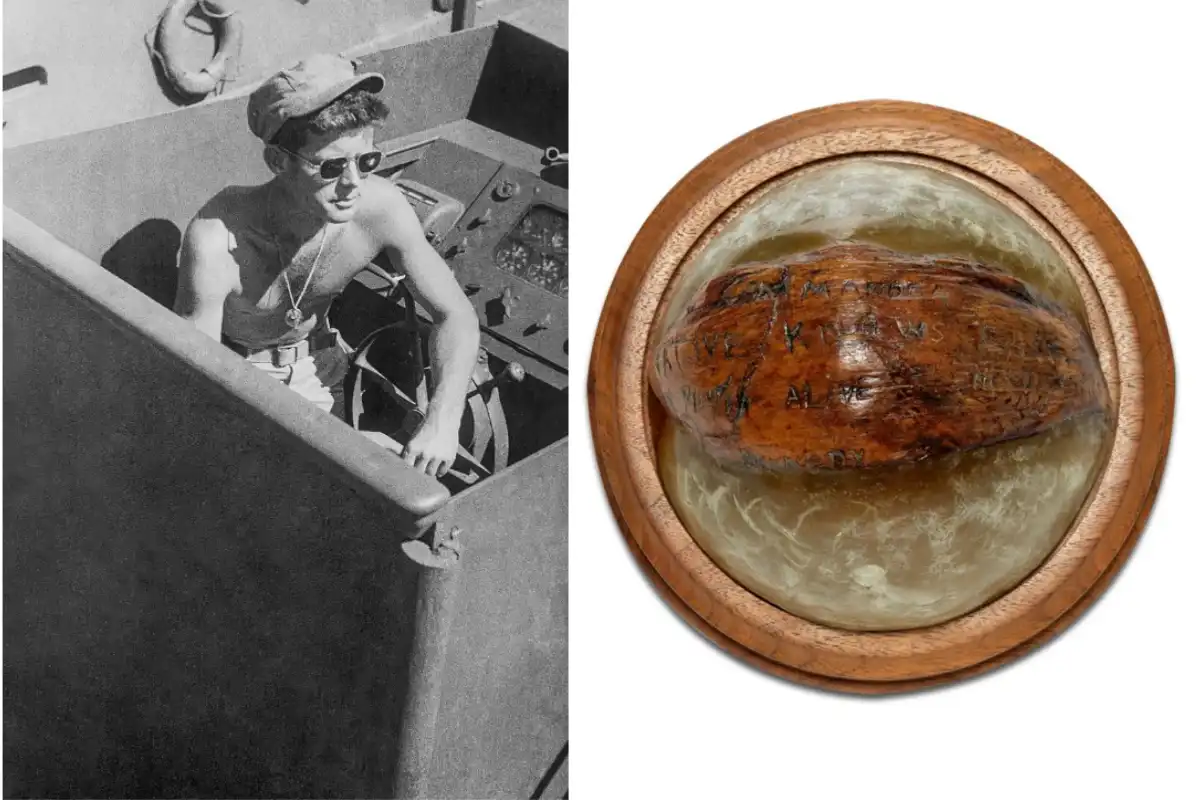
Before he was president, JFK’s quick thinking, and a carved coconut, saved his crew from certain death.
From Navy Officer to Reluctant Hero

Long before the world knew him as a charismatic president, John F. Kennedy was a 26-year-old Navy lieutenant fighting for survival in the South Pacific during World War II.
In 1941, Kennedy joined the Navy, determined to see active combat. By 1943, he was commanding a Patrol Torpedo (PT) boat, a small, fast craft used to intercept enemy ships.
On the night of August 1, 1943, Kennedy’s PT-109 was struck and destroyed by a Japanese destroyer while patrolling near the Solomon Islands. The collision split the boat in two, killing two men instantly and leaving Kennedy and 10 surviving crew members stranded in open water.
Despite suffering a serious back injury, Kennedy refused to give up. Gripping the strap of an injured sailor’s life jacket in his teeth, he towed the man over three miles to a tiny uninhabited island called Plum Pudding Island, a grueling swim that took more than 15 hours.
Survival Against the Odds
Once ashore, the men realized they had no food, no water, and no way to call for help.
They survived by drinking rainwater and eating foraged coconuts from the island’s palm trees, using the sharp shells to cut open the fruit. For four long days, Kennedy and his crew tried signaling for help, but rescue never came.
Hope returned when two local islanders, Biuku Gasa and Eroni Kumana, arrived by canoe. The men worked with Allied forces and were scouting the area when they discovered the stranded crew.
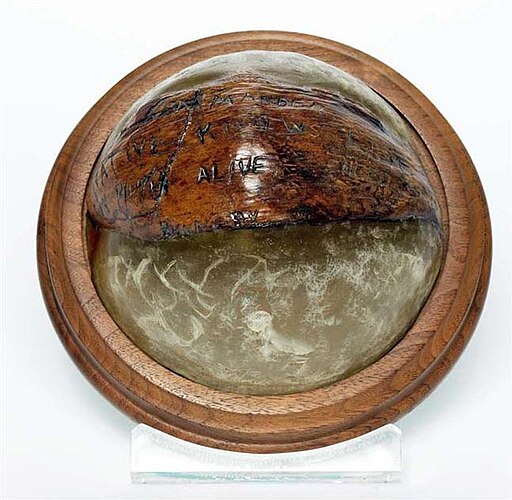
Kennedy needed a way to communicate their location without alerting enemy patrols. So he carved a message into a coconut husk and sent Gasa and Kumana to deliver it to nearby Allied forces.
The message read:
“NAURO ISL…COMMANDER…NATIVE KNOWS POS’IT…HE CAN PILOT…11 ALIVE…NEED SMALL BOAT…KENNEDY.”
The islanders paddled for miles through dangerous waters, risking their lives to reach a New Zealand command post led by Lt. A. Reginald Evans, who immediately launched a rescue mission.
On August 8, 1943, a week after the sinking, Kennedy and his surviving crew were rescued.
From Wartime Hero to Oval Office Symbol
Kennedy’s bravery earned him the Navy and Marine Corps Medal and the Purple Heart for his leadership and heroism.
When asked later about the ordeal, Kennedy downplayed his role:
“It was involuntary. They sank my boat.”
Still, the experience became a cornerstone of his public image, a story of courage, humility, and service under pressure.
Though Kennedy never met Gasa or Kumana again, he exchanged letters with them throughout his presidency. The island where the men landed was later renamed Kennedy Island in his honor.
After the rescue, Kennedy’s father, Joseph P. Kennedy, had the coconut husk preserved in plastic, and the future president kept it on his desk in the Oval Office as a symbol of perseverance and teamwork.
Today, the legendary coconut remains on display at the John F. Kennedy Presidential Library and Museum in Boston, an unlikely artifact that once carried a message powerful enough to save lives.
Watch the full story of JKF’s Resilience below:
Featured image: Wikipedia_John F. Kennedy