
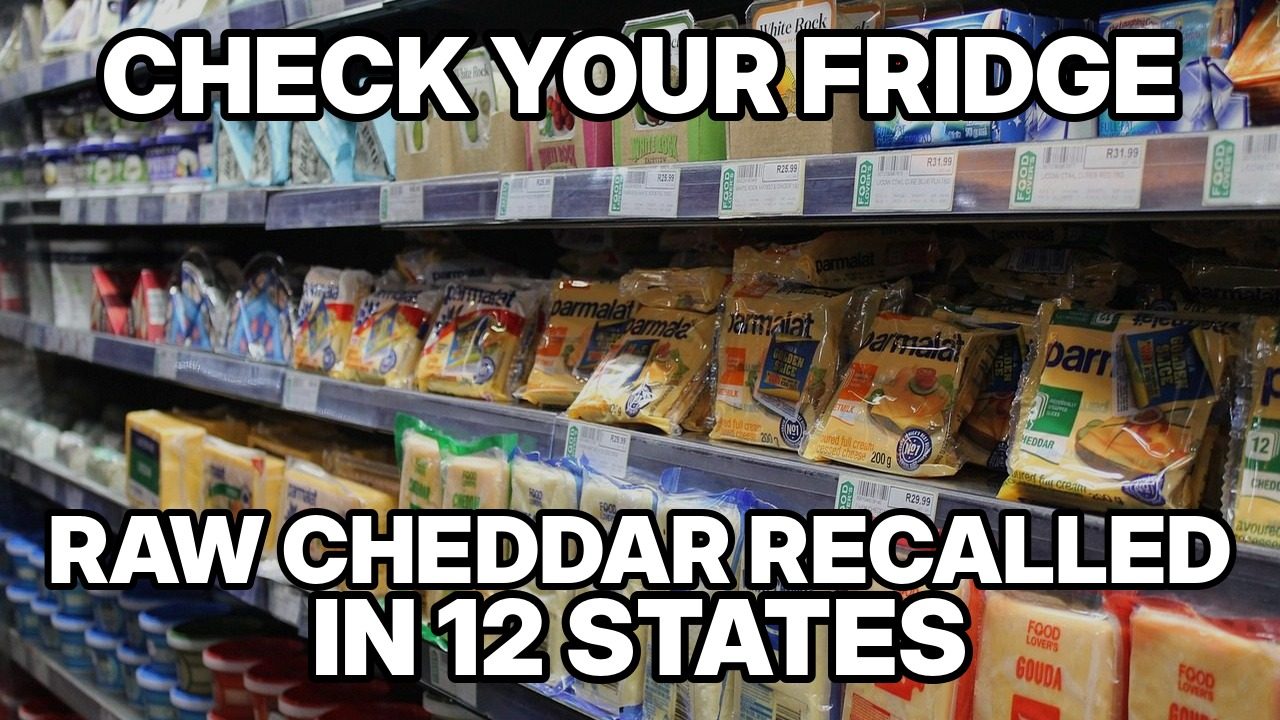
Family Farmstead Dairy is now recalling all of its raw mild and sharp cheddar in 12 states, weeks after an E. coli recall.
Family Farmstead Dairy of Worcester, New York, is recalling all of its raw mild and raw sharp cheddar because the cheese may be contaminated with Listeria monocytogenes, according to a company announcement posted by the FDA on November 10, 2026.
The raw cheddar recall covers 8-ounce, plastic-wrapped packages with lot codes dated 10/16/27 and earlier, sold through retail stores in 12 states, including New York and New Jersey. It comes less than four weeks after the company pulled one lot of raw mild cheddar over possible E. coli contamination.
Raw Cheddar Recall Now Covers 12 States
The November notice lists two products: Raw Mild Cheddar and Raw Sharp Cheddar, both in 8-ounce plastic wrap, with all lot codes dated 10/16/27 and prior. No other Family Farmstead Dairy products are included unless the company specifically identifies them.
It was distributed through retail stores in New York, New Jersey, Vermont, New Hampshire, Massachusetts, Pennsylvania, Rhode Island, Connecticut, Delaware, Virginia, West Virginia and Tennessee.
The company said the decision follows its October 15 recall of raw cheddar over E. coli. In the same notice, it explained the step this way: “This action is being taken as part of our ongoing commitment to continuous improvement and product excellence.”
It added that it “remains committed to producing safe, high-quality dairy products and maintaining the trust of the communities it serves.”
The announcement reports no illnesses and does not say how the possible contamination was found, Medical Daily noted.
October E. Coli Recall and Its Correction
The first recall came on October 15, 2026. It covered a single lot of Family Farmstead Dairy Raw Mild Cheddar Cheese with a lot code and best-by date of 7/22/27.
According to the company’s updated notice, the problem surfaced when a state food-testing sample in Maryland isolated two strains of Shiga toxin-producing E. coli, O26:H11 and O45:H2. They were found in two samples of Family Farmstead A2 Raw Cheddar in 8-ounce packages.
That version was a correction. The original notice, as the FDA emailed it, named E. coli O157:H7 and said the cheese went to grocers in New York and New Jersey only. The company issued the update “to correct the distribution pattern and serotype of E. coli.”
Under the correction, the states were New York, Pennsylvania, New Jersey, Connecticut, Maryland, Virginia and Massachusetts. The company said the cheese may also have reached other states through downstream distributors, and WABC-TV reported that no illnesses had been linked to the lot.
“We sincerely apologize to our customers, retail partners, and consumers for the inconvenience caused by this recall,” the company said at the time.
Family Farmstead also said it was “committed to identifying the cause of this issue and taking all necessary corrective actions.”
Which Packages to Check and What to Do
Shoppers in the affected states can check the date on the package against both notices:
- Listeria recall (November 10): Raw Mild Cheddar and Raw Sharp Cheddar, 8 ounces, plastic wrapped, all lot codes dated 10/16/27 and earlier.
- E. coli recall (October 15): Raw Mild Cheddar Cheese, lot code and best-by date 7/22/27, in clear plastic with green, red and white labeling.
For the October lot, the company told consumers not to eat the cheese and to throw it away or return it to the place of purchase for a full refund.
For the November recall, customers may return the cheddar to the store or contact Family Farmstead Dairy at (607) 397-4044, Monday through Friday from 8 a.m. to 5 p.m., or at [email protected].
Earlier this year, Delightful Daily covered repackaged M&M’s pulled from shelves in 20 states, another multistate product recall.

Why Listeria and E. Coli Are Serious
The November notice warns that Listeria can cause serious and sometimes fatal infections in young children, frail or elderly people and others with weakened immune systems. Healthy people may have only short-term symptoms such as high fever, severe headache, stiffness, nausea, abdominal pain and diarrhea.
The notice adds: “Listeria infection can cause miscarriages and stillbirths among pregnant women.”
According to the FDA, pregnant women are 18 times more likely to get listeriosis than other healthy adults. In pregnancy, the agency says, the most common sign is often just a fever or a flu-like illness, in a year when flu season arrived months early.
The FDA also says Listeria can grow and multiply at low temperatures, making it a potential problem even in properly refrigerated food. In one study the agency cites, the median time from eating the bacteria to falling ill in pregnant women was 27.5 days, with a range of 17 to 67 days.
The agency lists soft cheeses made with unpasteurized milk, along with unpasteurized milk products, among the foods the bacteria can contaminate. Pasteurization and cooking kill it.
The E. coli strains named in October cause a diarrheal illness, often with bloody stools, the company’s notice said. Most healthy adults recover within a week, but some people develop hemolytic uremic syndrome, a form of kidney failure most likely in young children and the elderly.
“The condition can lead to serious kidney damage and even death,” the notice said. Delightful Daily has written before about why a healthy gut matters.
About Family Farmstead Dairy
Family Farmstead Dairy describes itself as a New York-based dairy processor that maintains rigorous food safety and quality standards. Both recalls involve its raw cheddar, sold in 8-ounce packages.
FOX Business reported in October that the company could not immediately be reached for additional comment.
Neither notice reports an illness. Bacterial contamination is not limited to food: Delightful Daily has also reported on a woman’s eye infection linked to bacteria in eyedrops.
Featured image adapted from: AlbanyColley, via Pixabay