
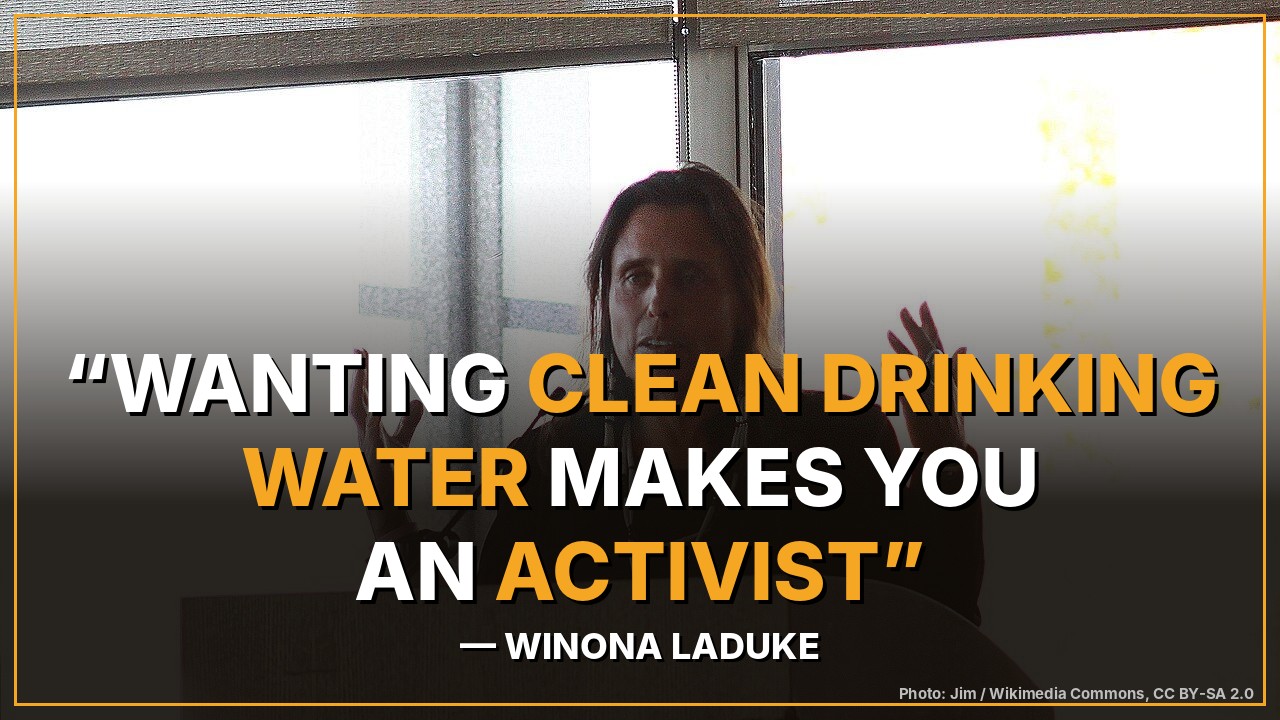
A viral meme rewords her 2013 question. Her real story runs from a Line 3 arrest to an aquifer breach that cost Enbridge millions.
A meme credited to Winona LaDuke has been making the rounds with a blunt question: why does wanting clean drinking water make someone an activist, when a corporation that poisons it is never called a terrorist?
When Delightful Daily shared it on Facebook on Oct. 11, the post drew more than 300 comments. Like many viral posts about corporate power, it spread on one simple question, and the caption ended on another: should companies that pollute water face tougher consequences?
The words on the image are not quite LaDuke’s. The question is. It goes back to an essay she wrote in 2013, and years later it followed her into a Minnesota jail.
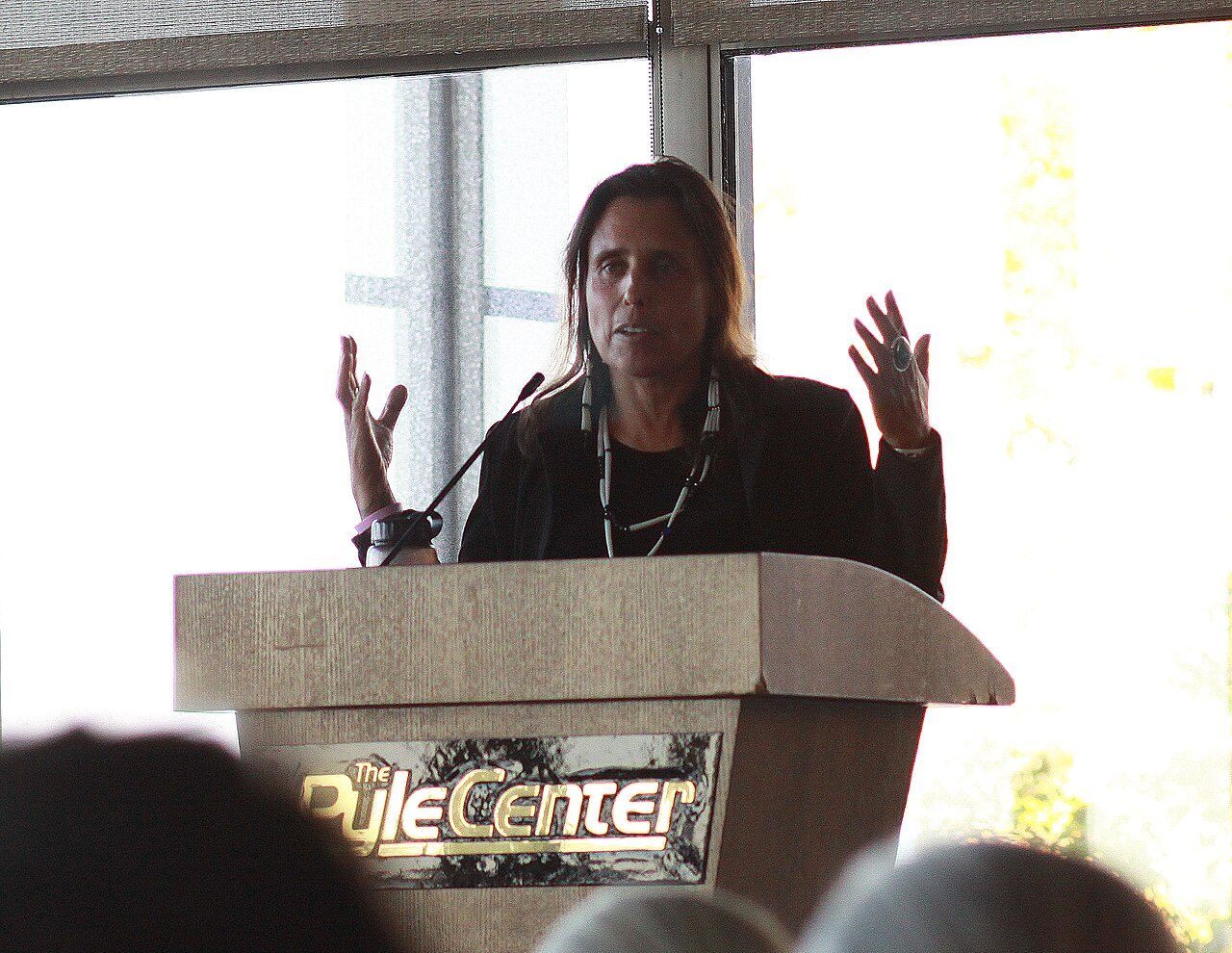
Where the Viral Water Quote Comes From
The version on the meme reads: “Why does wanting clean drinking water make you an activist, while poisoning it doesn’t make a corporation a terrorist?” Quote researcher Barry Popik, who traced the saying’s history, describes it as a saying printed on many images, usually beside a picture of LaDuke.
Popik followed it back to a longer line that LaDuke actually wrote. It is the first sentence of her 2013 essay When Drones Guard the Pipeline: Militarizing Fossil Fuels in the East, published by Indian Country Today Media Network:
“Someone needs to explain to me why wanting clean drinking water makes you an activist, and why proposing to destroy water with chemical warfare doesn’t make a corporation a terrorist.”
The difference matters. LaDuke did not accuse anyone of poisoning water. She wrote about a company proposing to destroy it, and she was writing about a specific fight.
She wrote from South Dakota, on the route of the proposed Keystone XL pipeline. Her target was the policing of protests in New Brunswick, Canada, where Royal Canadian Mounted Police arrested people opposing seismic testing for shale gas by Texas-based Southwestern Energy in June 2013. Canadian law requires consultation with First Nations, she wrote, and it had not happened.
No source found for this article shows LaDuke using the shorter meme wording. Popik’s log shows versions credited to her circulating on X, Facebook and Bluesky since at least 2014, with the short “poisoning” version turning up on Facebook in July 2026.
The essay closed on a hope: “I am hoping that people who want to protect the water are treated with respect.”
Jailed Over Line 3 While Enbridge Paid a Fine
Eight years later, LaDuke tested that hope herself.
In July 2021, she and other women were arrested for trespassing while sitting together, praying and protesting construction of Enbridge’s Line 3 oil pipeline at the Shell River near Park Rapids, Minnesota, the Minnesota Reformer reported. The pipeline crosses that river five times. She spent three days in jail.
She was charged with trespassing, harassment, two unlawful assembly misdemeanors and public nuisance, and posted a $6,000 bond, according to court documents cited by the Reformer.
Speaking to Democracy Now! the day after her release, she put it simply: “I was arrested because I wanted to stop Enbridge’s Line 3 from crossing the Shell River.” The program put the number of people arrested in Line 3 protests by then at nearly 600.
Enbridge told the Reformer that police, not the company, decide when protesters are breaking the law. “As a company, we recognize the rights of individuals and groups to express their views legally and peacefully, but we will not tolerate illegal acts,” its statement said.
The company has said its rerouted replacement line is safer for the environment over the long term. Opponents argue it violates an 1855 treaty guaranteeing Native Americans the right to hunt, fish and gather wild rice, CBS Minnesota reported. In 2023, a Wadena County prosecutor dismissed the last charge against LaDuke.
By then, Enbridge had faced a case of its own. In October 2022, Minnesota Attorney General Keith Ellison charged the company with one misdemeanor over an aquifer its crews punctured during construction. The charge would be dismissed after a year if Enbridge paid a $1,000 fine and stayed law-abiding, MPR News reported.
LaDuke welcomed the charge, and then asked the question that sits under the meme. “I also ultimately wonder why I went to jail and Enbridge did not,” she said.
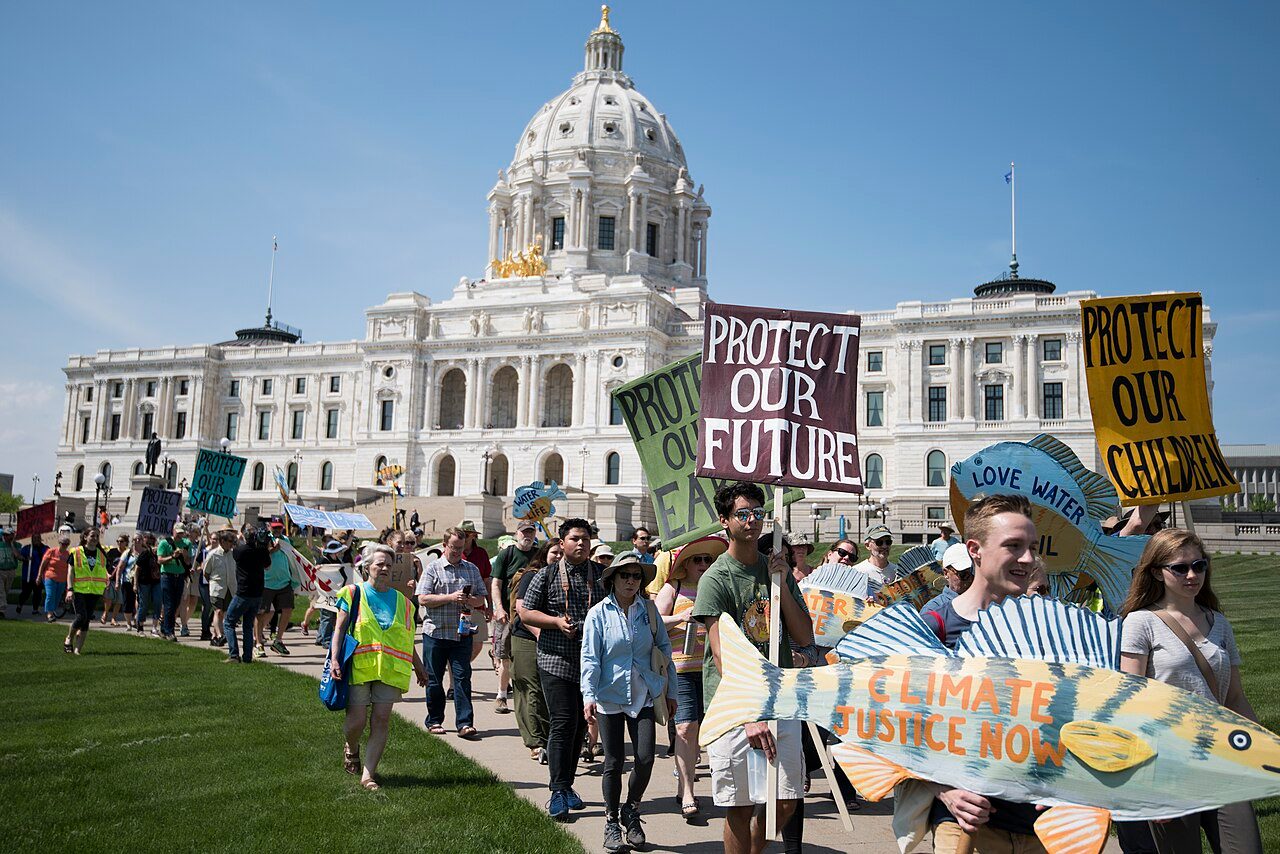
Who Is Winona LaDuke?
LaDuke is an Anishinaabekwe (Ojibwe) enrolled member of the Mississippi Band Anishinaabeg, born in 1959 in California, according to her National Women’s Hall of Fame biography. She graduated from Harvard and Antioch universities and spoke to the United Nations about Native American concerns at 18.
After moving to the White Earth reservation in Minnesota, she founded the White Earth Land Recovery Project. In 1985 she established the Indigenous Women’s Network. She ran twice for vice president, in 1996 and 2000, on Ralph Nader’s Green Party ticket, and entered the Hall of Fame in 2007.
She also co-founded Honor the Earth, a Native environmental group that was heavily involved in the 2016 Dakota Access Pipeline protests at Standing Rock. That record puts her alongside other Native American leaders who carried tribal causes onto a national stage.
Water runs through her writing. In the same 2013 essay, she wrote: “The Lakota understand that water is life, and that there is no new water.”
What the Line 3 Aquifer Breach Cost
The aquifer case began at Enbridge’s Clearbrook Terminal in early 2021. The company’s plans called for a trench 8 to 10 feet deep. Instead it dug about 18 feet, with sheet piling driven to 28 feet, and breached the confining layer of an artesian aquifer, the Minnesota Department of Natural Resources said. Enbridge did not notify the agency.
Through Sept. 5, 2021, about 24.2 million gallons of groundwater flowed out, the DNR said.
The agency ordered Enbridge to pay $3.32 million. That covered $300,000 for lost groundwater, $250,000 to monitor nearby wetlands, $2.75 million in escrow for restoration, and a $20,000 administrative penalty, which the DNR said was the maximum state law allows.
“Enbridge’s actions are clear violations of state law and also of public trust. This never should have happened, and we are holding the company fully accountable,” DNR Commissioner Sarah Strommen said.
Ellison said a misdemeanor was the only charge the state could support under current law, but called it “an important step forward in holding Enbridge accountable for the damage it caused to Minnesota’s water and environment.”
With other enforcement actions added in, covering drilling-mud releases at a dozen locations and two more aquifer breaches, Enbridge’s total came to more than $11 million in penalties, environmental projects and financial assurances, MPR News reported.
Enbridge acknowledged that it breached the aquifer near Clearbrook by accident, but said it fundamentally disagrees that it committed any crime. “When events were identified, Enbridge reported them transparently and corrected them consistent with plans approved by the agencies,” the company said.
LaDuke was not satisfied. “Remember that the aquifer is still hemorrhaging water and the level of contamination is increasing,” she said in 2022.
Water use was already a sore point. In 2021, the DNR had let Enbridge raise the amount of water it could temporarily pump from aquifers during construction from half a billion to nearly 5 billion gallons, the Reformer reported.
Why PFAS and Petroleum Linger in Water
LaDuke’s line was about a gas company in Canada, not any particular chemical. The Facebook caption, though, named two kinds of contamination: PFAS and petroleum. On both, the federal record supports its point that the damage lasts.
PFAS are widely used, long-lasting chemicals whose components break down very slowly over time, the EPA says. Because they persist, many are found in the blood of people and animals all over the world, and in water, air, fish and soil. The agency says exposure to some PFAS may be linked to harmful health effects.
In April 2024, the EPA set enforceable drinking water limits for six PFAS, including 4.0 parts per trillion for PFOA and PFOS, and gave water systems until 2029 to comply. The agency said the rule would prevent PFAS exposure for about 100 million people, according to its PFAS rule page.
That rule is now in flux. On May 18, 2026, the EPA proposed keeping the PFOA and PFOS limits while letting systems request two more years, to 2031. A second proposal would rescind the limits for PFHxS, PFNA, GenX and a combined Hazard Index measure. Both are still proposals, not final rules.
Petroleum is the older problem. More than 581,000 releases from leaking underground storage tanks had been confirmed nationwide as of September 2025, according to the EPA. Nearly 528,000 sites have been cleaned up, and about 54,000 are still waiting.
Some of those sites affect drinking water and need years of cleanup costing millions of dollars, the EPA says, while others are restored quickly and cheaply. State cleanup funds spend about $1 billion a year, on top of federal money and what responsible parties pay.
For the people living nearby, these numbers are rarely abstract, as recent community backlash over industrial pollution has shown.
How Polluters Are Actually Penalized
So what happens to a company that pollutes water? Under the Clean Water Act, a court can impose a civil penalty for each day of each violation. The law as written sets the cap at $25,000 per day for each violation, and after inflation adjustments the maximum is $68,445, according to the EPA’s current penalty table.
Courts do not simply reach for the top figure. The law tells them to weigh how serious the violation was, any economic benefit the violator gained, its history, any good-faith efforts to comply, and the economic impact of the penalty on the violator.
The largest recent water-pollution payouts have come from lawsuits, not fines. In March 2024, a federal court in South Carolina gave final approval to 3M’s settlement with U.S. public water suppliers over PFAS. 3M said it will pay a present value of up to $10.3 billion over 13 years, with a nominal cap of $12.5 billion.
In February 2024, a federal court approved DuPont, Chemours and Corteva paying $1.185 billion to settle public water systems’ PFAS claims, according to the Association of State Drinking Water Administrators. Personal-injury claims and state claims over damage to natural resources were left out of that deal.
Set beside those sums, Minnesota’s administrative penalty for the Line 3 aquifer breach topped out at $20,000, the DNR said.
When Protesters Face the Bigger Bill
Sometimes the bill runs the other way. On March 19, 2025, a North Dakota jury awarded pipeline developer Energy Transfer nearly $667 million against three Greenpeace organizations over their alleged role in the 2016 Standing Rock protests against the Dakota Access Pipeline, Inside Climate News reported.
Energy Transfer argued that Greenpeace orchestrated the protests. Greenpeace says it played a minor supporting role and got involved at the request of the Standing Rock Sioux. In February 2026, the court entered judgment for $345 million, and Greenpeace says it will seek a new trial or appeal.
LaDuke was at Standing Rock. In a column for the Duluth News Tribune, she wrote that she never saw Greenpeace there and called the case the largest SLAPP suit, a lawsuit aimed at silencing public participation, in North Dakota history. “Native people came for the river and were punished for it,” she wrote.
For protesters anywhere, the case shows that civil disobedience can bring a civil judgment as well as an arrest.
LaDuke’s own charges were dismissed. Enbridge’s aquifer case ended in a misdemeanor deal, millions in state orders and a company that still says it committed no crime. Her 2013 question is still being shared, now in words that are not quite hers.
Should companies that pollute water face tougher consequences? Tell us what you think in the comments.
Featured image from: Sarah Deer from Saint Paul, USA, CC BY 2.0, via Wikimedia Commons