

Uneven shadows, starless skies, and a rippling American flag have fueled one of history’s most enduring conspiracy theories, but the evidence still overwhelmingly supports one conclusion: we really did land on the Moon.
Why People Started Asking: Was The Moon Landing Fake?
On July 20, 1969, millions watched as Neil Armstrong stepped onto the lunar surface and declared, “That’s one small step for man, one giant leap for mankind.” It was a defining moment in the 20th century, a technological triumph, a political victory, and a cultural milestone.
But it was also the height of the Cold War.
The United States and the Soviet Union were locked in a tense geopolitical and technological rivalry known as the Space Race. The U.S.S.R. had already shocked the world by launching Sputnik, the first artificial satellite, and sending the first human, Yuri Gagarin, into space. American officials were under immense pressure to prove the United States could not only keep up, but surpass the Soviets.
Landing on the Moon was the ultimate way to do that.
To most of the world, Apollo 11 was a stunning success. But for some, it was a little too perfect. If the stakes were that high, they reasoned, wouldn’t NASA do anything to win, even fake the entire thing on a sound stage?
Unlike some conspiracies (such as the idea that the Earth is flat), the Moon hoax theory at least starts from a premise that makes emotional sense: the U.S. government had a clear motive to appear victorious. From there, doubt, distrust, and misunderstanding of science did the rest.
The Birth Of The Moon Hoax: Bill Kaysing’s Pamphlet
Whispers that the Moon landing might be fake began in the mid-1970s, after the initial excitement over Apollo had faded. A few people speculated that NASA, desperate for a win, might have staged the whole thing.
But the theory didn’t truly take off until 1976.
That year, Bill Kaysing, a former U.S. Navy officer and English major, self-published a pamphlet called We Never Went to the Moon: America’s Thirty Billion Dollar Swindle. Kaysing had worked as a technical writer for Rocketdyne, the company that built engines for the Saturn V rocket that carried Apollo astronauts to the Moon. He had no formal training in rocket science, but his proximity to the space industry helped his claims appear more credible to the public.
In his pamphlet, Kaysing argued that the odds of successfully landing on the Moon were so low that faking the mission would have been easier and more reliable. He suggested NASA could have staged the landing on a sound stage, even if Soviet spies were watching.
Whether or not his “evidence” held up (it did not), his claims landed at just the right time. The Apollo program had ended, national attention had shifted elsewhere, and distrust of government was still high after events like Watergate and the Vietnam War.
Kaysing was soon appearing on radio shows and TV programs, explaining why he believed the Moon landing was a hoax. He became known as “The Father of the Moon Hoax Theory”, later insisting that his goal was to get people to question authority.
What he may not have anticipated was how far others would eventually push his idea.
How The Flat Earth Society Supercharged The Conspiracy
Four years after Kaysing’s pamphlet, the Moon hoax theory was picked up by another fringe group: the International Flat Earth Research Society.
Its president, Charles K. Johnson, believed that the Earth was not a globe but a flat disk, and that modern science, particularly space exploration, was part of a large-scale attempt to undermine the Bible and remove Jesus from public life.
“The facts are simple. The Earth is flat,” Johnson told Science Digest in 1980.
Johnson’s religious beliefs strongly shaped his worldview. He argued that if Jesus ascended “up” into Heaven, the universe must be structured in a way that supports an absolute “up” and “down.” For him, the “spinning ball” model of Earth, the Copernican system, was an attack on scripture.
“The whole point of the Copernican theory is to get rid of Jesus by saying there is no up and no down,” he claimed. “The spinning ball thing just makes the whole Bible a big joke… Reasonable, intelligent people have always recognized that the Earth is flat.”
He even insisted that “Moses was a Flat-Earther,” “Columbus was a Flat-Earther,” and that the Church once taught that “the world is a ball” only later. According to Johnson, it wasn’t until the supposed Moon landings and the release of photos of a spherical Earth from space that people began to “convert” to the idea of a round planet.
“Almost no one considered the world a ball,” he said. “The landings converted a few of them, but many are coming back now and getting off of it.”
For Johnson and the Flat Earth Society, the Moon landing hoax theory was a perfect fit: if space travel was fake, so were the images of Earth from orbit. The two conspiracies became tightly linked, and remain so today.
Inside The “Evidence” That The Moon Landing Was Fake
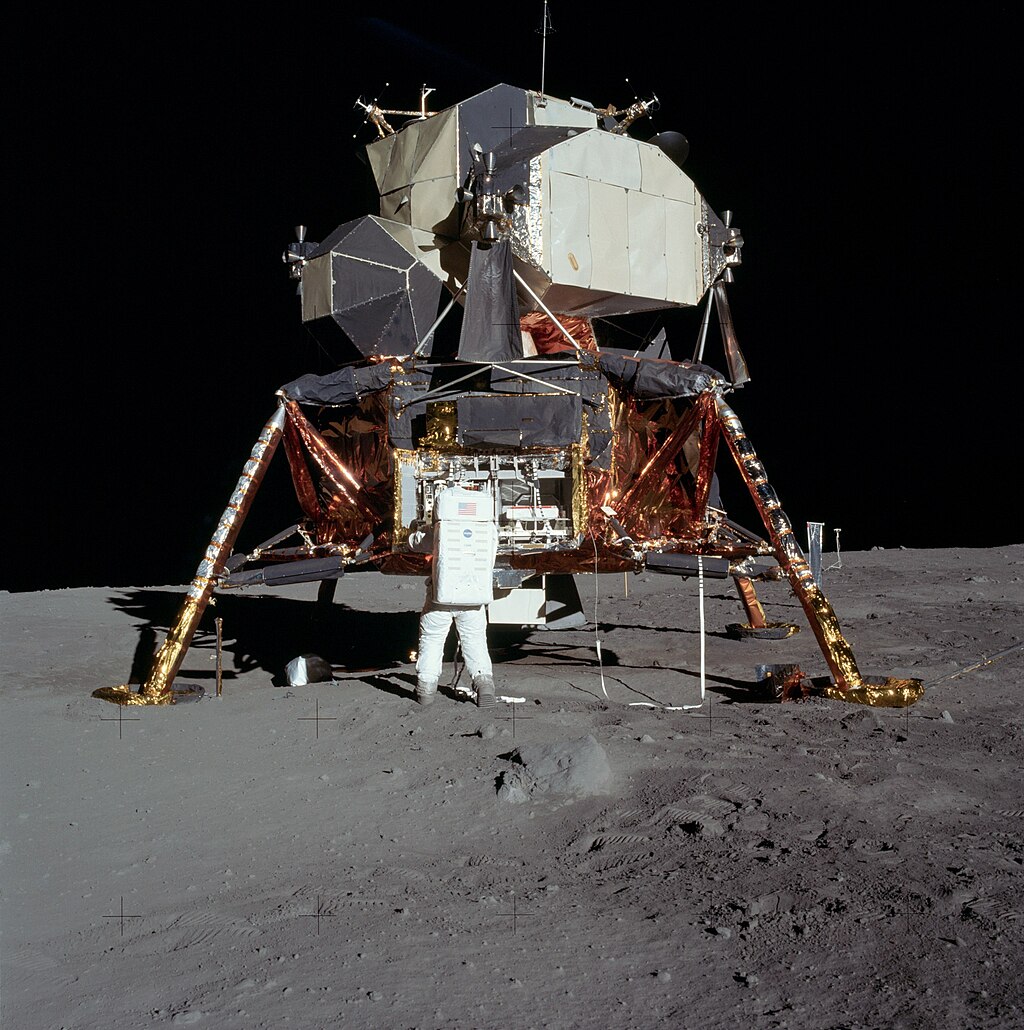
Moon landing deniers often point to a few key details in photos and videos from Apollo 11. Some of these include:
- The “waving” American flag
In famous photographs and video from the Moon, the American flag appears to ripple, as if it’s blowing in the wind. Since there is no air on the Moon, conspiracists argue this proves the scene was filmed on Earth. - The lack of stars in the lunar sky
In images from the Moon’s surface, the sky looks black and starless. Skeptics claim that NASA intentionally left stars out because it would be too difficult to accurately simulate constellations on a movie-style backdrop. - Uneven or strange-looking shadows
Conspiracy theorists say that the way shadows fall in some photos suggests multiple light sources, like studio lighting, rather than the single light source of the Sun. - No obvious cameras in astronauts’ hands
Neil Armstrong and Buzz Aldrin rarely appear to be holding cameras, which leads some to wonder how the photos were taken in the first place.
On their own, and without context, these oddities can look suspicious. To someone already inclined to distrust governments or scientific institutions, they can feel like “smoking gun” proof.
But each of these claims has a straightforward explanation grounded in basic physics, photography, and the realities of the Moon environment.
What Science (And NASA) Say Actually Happened
Debunking the Moon hoax claims doesn’t require blind faith in institutions. It simply requires looking at all the evidence, and understanding a bit of science.
In 2019, NASA’s former chief historian Roger Launius spoke to the Associated Press about why the Apollo 11 conspiracy theory has survived and addressed some of its most popular claims.
Why does the flag look like it’s waving?
The American flag on the Moon was designed with a horizontal rod across the top to hold it out, since there is no wind to unfurl it. During setup, astronauts jostled the pole and bent the rod slightly, creating permanent ripples in the fabric.
The result: the flag looks like it’s fluttering, but it’s actually just crinkled fabric in low gravity, held out by a bar.
Why are there no stars in the photos?
When Armstrong and Aldrin were on the lunar surface, it was daytime on the Moon. The Sun was shining brightly, and the Moon’s surface is highly reflective. To properly expose the astronauts and the ground, the cameras used fast shutter speeds and smaller apertures.
Those settings are far too bright to capture faint starlight, just like when you photograph a city skyline at noon and don’t see stars in the sky, even though they are there.
Why do the shadows look strange?
The Moon’s surface is uneven and reflective, and the Sun’s low angle creates complex shadow patterns. Additionally, light can reflect off the ground and the astronauts’ white suits. What looks like “multiple light sources” is just the result of light bouncing in an alien environment that we’re not used to seeing.
Where are the cameras?
Astronauts needed their hands free to move and work, especially in bulky spacesuits. So the cameras were mounted on their chests, not held like a tourist’s handheld camera. That’s why you rarely see them “holding” a camera in photos, it was built into their suit configuration.
Why The Moon Landing Conspiracy Refuses To Die
Today, the vast majority of scientists, historians, and engineers, along with overwhelming physical evidence, support the conclusion that humans did, in fact, land on the Moon in 1969.
We have:
- Moon rocks brought back by multiple Apollo missions
- Retroreflectors left on the lunar surface that can still be targeted with lasers from Earth
- Independent tracking records from observatories and other nations
- Thousands of people who worked on the Apollo program, across many companies and countries
Yet, surveys suggest that around five percent of Americans believe the Moon landing was faked, more than 16 million people.
Why?
Part of the answer lies in psychology. Conspiracy theories can be comforting in a strange way: they turn complex, difficult-to-grasp events into simple stories about good and evil, heroes and villains, liars and truth-tellers. They appeal to people who feel alienated, distrustful, or left out of mainstream narratives.
It’s also easy, decades later, to look at grainy black-and-white footage and think, “There’s no way we did this in 1969.” The technology feels too primitive by modern standards, and our everyday understanding of physics is limited. That gap between perception and reality creates space for doubt.
What many conspiracists don’t acknowledge, however, is that the people pushing these theories often have their own motives, whether it’s fame, book sales, or a desire to undermine trust in scientific institutions.
The Moon landing conspiracy theory survives not because the evidence for Apollo 11 is weak, but because doubt, once planted, can be incredibly hard to uproot.
In the end, the question “Was the Moon landing fake?” says less about NASA, and more about how we grapple with trust, authority, and the limits of our own understanding.
Featured image from: NASA, Public domain, via Wikimedia Commons