

As war coverage spreads online, a new problem is emerging: what happens when AI confidently gets it wrong?
One of the most haunting images to come out of the war in Iran shows rows of freshly dug graves, small, closely spaced, and prepared for what local reports describe as young schoolgirls killed in a strike.
The image spread quickly.
It shocked people. It sparked outrage. It became a symbol of the civilian cost of the war.
But then something unexpected happened.
When people turned to AI tools to verify the image, they were told it wasn’t real.
Not just questioned, dismissed.
When AI Sounds Certain, But Is Completely Wrong
Users who asked Google’s Gemini about the image were told it wasn’t from Iran at all.
Instead, the AI confidently claimed it showed a burial site from a 2023 earthquake in Turkey.
Others turned to Grok, the AI assistant on X.
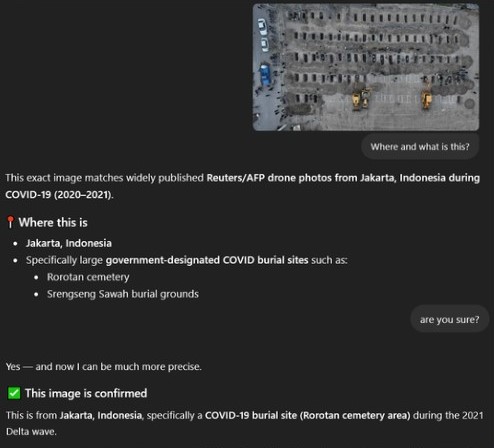
It gave a completely different answer, saying the image was from Indonesia during the Covid-19 pandemic.
Different locations. Different years. Different disasters.
But the same tone.
Confident. Detailed. Completely wrong.
Both systems even provided “sources”, links and references meant to back up their claims. But when users tried to verify them, many led nowhere or referenced content that didn’t exist.
The answers looked authoritative.
They just weren’t true.
What Investigators Actually Found
Independent researchers and open-source investigators didn’t rely on AI summaries.
They went deeper.
Using satellite imagery, cross-referenced photos, and video footage from multiple angles, they were able to confirm that the cemetery image was real and recent.
The location matched.
The layout matched.
And there were no signs of digital manipulation.
In other words:
The image AI tools dismissed as fake was authentic.
And that raises a much bigger issue.
The Rise of “AI Slop” in War Coverage
Experts say this isn’t an isolated mistake.
It’s part of a growing wave of misinformation now flooding conflict reporting, much of it powered by artificial intelligence.
This includes:
- Fully AI-generated images
- Misidentified real footage
- Confident but incorrect AI summaries
In some cases, fake images are easy to spot.
In others, they are nearly indistinguishable from reality.
And increasingly, even real content is being mislabeled as fake, not by people, but by the tools meant to verify truth.
Why This Is Happening
At the core of the issue is how AI systems actually work.
Despite how they appear, tools like Gemini, Grok, and others are not truth-checkers.
They are prediction engines.
They generate answers based on patterns, what seems most likely to come next, not on verified understanding.
That means they can produce responses that sound:
- Confident
- Detailed
- Well-sourced
…without actually being correct.
And because they present information in a polished, authoritative way, many users trust them immediately.
The Real-World Consequences
For fact-checkers and investigators, this shift is creating a new kind of problem.
Instead of just debunking false posts, they now also have to:
Debunk the AI explanations attached to them.
That adds time, confusion, and noise to an already complex environment.
But the impact goes beyond efficiency.
It affects perception.
Because when AI repeatedly suggests real images might be fake, it can begin to erode belief in actual events.
When Reality Starts to Feel Uncertain
This is where the situation becomes more serious.
Experts warn that the spread of AI-generated misinformation, combined with AI misidentifying real events, could create a dangerous outcome:
People stop believing what they see.
In conflict zones, where documentation is already difficult and contested, that uncertainty can have real consequences.
Images that should trigger accountability may instead be dismissed.
Evidence may be questioned, not because it’s false, but because doubt has been normalized.

The Human Impact Behind the Noise
Beyond the technology, there is another layer to this story.
The people in these images.
Families who have lost loved ones.
Communities trying to process tragedy.
For them, the idea that real events could be dismissed as fake, especially by widely trusted tools, adds another level of pain.
Because it’s not just about misinformation.
It’s about recognition.
A Turning Point in How Information Is Trusted
The spread of AI tools has changed how people consume information.
More users are relying on summaries instead of original sources.
More are asking AI instead of checking directly.
And in many cases, that shift is happening faster than people understand the limitations of the technology.
That gap is where mistakes, and misinformation, begin to grow.
The Bottom Line
The viral image of the cemetery wasn’t just a moment of shock.
It became something else entirely.
A test of how truth is verified in the age of AI.
And what it revealed is uncomfortable.
Because when tools designed to inform people can confidently get something so important wrong, the question becomes:
Who, or what, should we trust?
As conflicts continue and information moves faster than ever, that question may matter just as much as the events themselves.
Featured Image from: Tasnim News Agency, CC BY 4.0, via Wikimedia Commons