
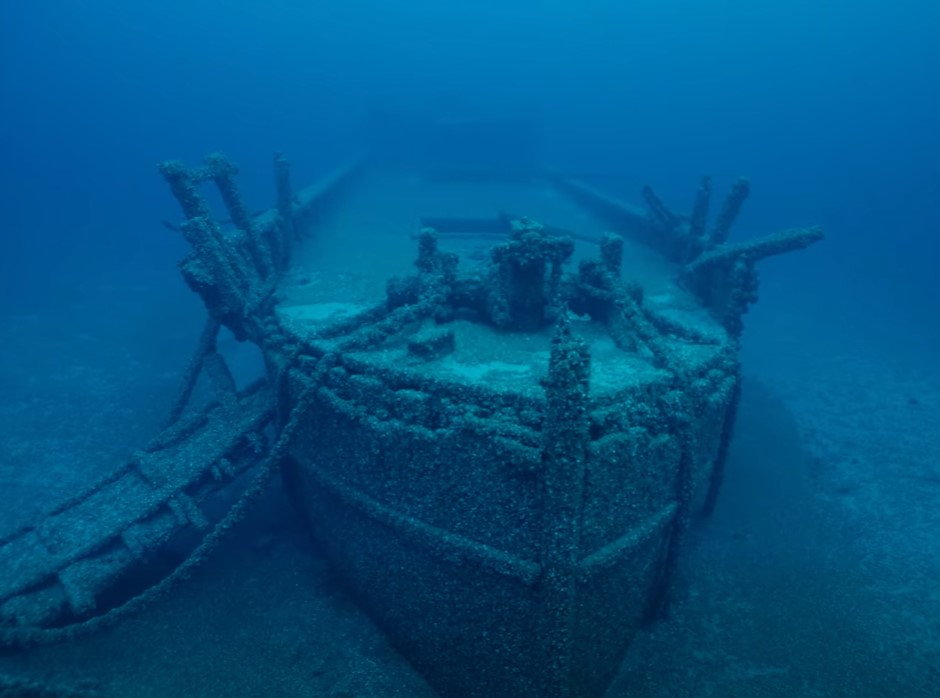
The vessel, which disappeared with 11 crew members during a snowstorm, has been identified nearly intact 280 feet below the surface, and covered in invasive quagga mussels.
A Routine Filming Trip Turns Into a Historic Discovery
Yvonne Drebert and Zach Melnick were not searching for a missing 19th-century ship when they set out onto Lake Huron one afternoon in June. The documentary filmmakers were investigating the ecological impact of invasive mussels, a longstanding focus of their work, when a tip from a U.S. Geological Survey contact shifted their attention to an unexplained sonar reading on the lakebed.
The “anomaly,” they were told, was likely just a pile of rocks. Still, they deployed a remotely operated vehicle equipped with an ultra–low-light, high-resolution camera to verify it.
“Surprise, surprise,” Melnick said, according to Canadian Geographic. “We have mussels.”
“Shocking,” Drebert replied.
As the ROV descended 280 feet, a large silhouette emerged from the darkness. What looked at first like a mass of quagga mussels soon revealed the fully formed shape of a ship resting upright on the lake floor.
The vessel was nearly intact, preserved by cold, deep water but coated so heavily in mussels that its identifying features were obscured.
Identifying the Wreck Beneath the Mussels

Because quagga mussels have fused themselves to nearly every inch of the wooden hull, scraping them away was not an option; doing so would damage the structure and violate the Ontario Heritage Act. Drebert and Melnick therefore registered the site as an archaeological location and turned to dimensions, layout, and nearby debris for clues.
Working with a marine archaeologist and a local historian, they narrowed the possibilities to three missing ships. Coal fragments near the wreck ultimately provided the breakthrough. The vessel matched the profile of the Africa, a once-passenger ship later converted into a steam barge for Great Lakes cargo transport.
The Africa vanished in 1895 after becoming disconnected from the Severn, a smaller barge it had been towing through a snowstorm. The Severn eventually ran aground and its crew survived. The Africa never resurfaced.
A Ship Lost to a Harsh Era of Great Lakes Travel
The late 19th and early 20th centuries were perilous for sailors on the Great Lakes, where sudden storms and extreme winds regularly wrecked vessels. Marine historian Patrick Folkes told Canadian Geographic that at least 100 ships were lost or destroyed near the Saugeen Peninsula between 1848 and 1930, and roughly half remain undiscovered.
“Sometimes the only clue [that a ship had been lost] was when bodies or wreckage washed ashore,” Folkes said.
In the case of the Africa, five bodies were found in the years following the disappearance. The remaining crew members are believed to still be inside the wreck.
“It’s a human tragedy; those lives were lost,” Folkes added. “I always think of those poor sailors. They had pretty tough lives and ended up getting drowned in Lake Huron.”
The Invasive Mussels That Revealed, and Threaten, the Wreck
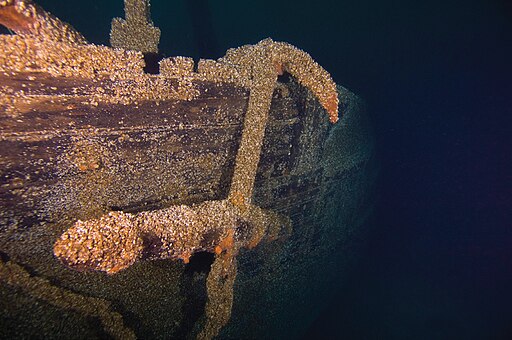
Quagga mussels, native to southern Russia and Ukraine, arrived in the Great Lakes through ballast water discharged from cargo ships. Their ecological impact has been severe. Each mussel is small, only about two centimeters, but can filter one liter of water per day. In massive colonies, they strip the lake of plankton, starving native fish species.
“It’s become so difficult to make a living from fishing that most individuals have had to get out of it,” said Ryan Lauzon, Fisheries Management Biologist for the Chippewas of Nawash Unceded First Nation.
But while devastating to fisheries, quagga mussels have unintentionally improved underwater visibility. By removing suspended plankton at extraordinary rates, they have made deep water clearer than it has been in decades.
“There are so many quaggas filtering the Great Lakes, that the lakes are up to three times as clear as they were before the mussels,” Drebert told CBS. “The quaggas are the reason we’re able to see the shipwreck in almost 300 feet of water without any additional lights. But they’re also responsible for making wreck identification in the Great Lakes incredibly difficult.”
Preservationists warn that mussels also threaten the long-term survival of shipwrecks. Their colonies cling to wood and metal, accelerating deterioration. According to CBC News, experts estimate that within two decades, many submerged vessels may become unidentifiable.
Melnick noted the dual impact of the mussels: “Before discovering the Africa, our work focused on the ecological impacts of the mussels, which have devastated fisheries around the lakes. We hadn’t considered the effect they could have on our cultural heritage. But the mussels have truly changed everything in the deep waters of the Great Lakes.”
The Cultural and Scientific Value of the Find
The discovery of the Africa closes a long-standing historical question and provides rare insight into late 19th-century shipping infrastructure. Few vessels from that era have been found so well preserved.
It also advances efforts to document the region’s underwater heritage before invasive species permanently alter or destroy it. For researchers studying the intersection of ecology and maritime history, the wreck demonstrates how one environmental crisis can unexpectedly illuminate another part of the past.
For local communities whose ancestors worked on the Great Lakes, the find is both a historical milestone and a solemn reminder of the dangers sailors faced.
What Comes Next for the Africa
Drebert and Melnick’s footage will appear in their upcoming documentary, All Too Clear, which examines how invasive mussels have reshaped the Great Lakes, visually, ecologically, and historically.
No recovery of the vessel is planned. Because human remains may still be inside, the wreck is treated as a gravesite and protected as a cultural resource. Future research will rely on imaging rather than physical disturbance.
Still, the discovery ensures that the story of the Africa, its disappearance, its crew, and its place in Great Lakes history, is no longer lost beneath the surface.
Featured Image Screenshot from Facebook: All Too Clear Film