

Archaeologists at the Villa Romana del Casale have unearthed yet another stunning Roman mosaic, a detailed depiction of Roman sandals created in the 4th century C.E.
A New Mosaic Emerges From One of the Roman World’s Most Lavish Villas
Archaeologists working inside the thermal baths of the Villa Romana del Casale in Piazza Armerina, Sicily, have uncovered a remarkably preserved mosaic showing a pair of Roman sandals that closely resemble modern flip-flops. The artwork, found in the southern baths, adds to the villa’s extensive collection of mosaics and highlights the site’s reputation as one of the most visually rich residences of the late Roman Empire.
The discovery was announced by the Parco Archeologico di Morgantina, which noted that the sandals mosaic appeared near another piece featuring white text on a red background, though the message has not yet been deciphered. The surrounding room was decorated with colorful tiles, and the bathing pool itself had a band of mosaic around its upper edge, pointing to the overall luxury of the villa.
The sandals mosaic stood out immediately due to its intricate craftsmanship. Despite being only a small part of a larger design, the level of detail suggests the work of a highly trained artisan active during the 4th century C.E., roughly 150 years before Rome’s fall.
In addition to the mosaic, archaeologists uncovered three columns and their capitals. These discoveries were made with assistance from students participating in the University of Bologna’s ArchLabs Summer School, an international field program involving 40 students from 11 countries.
Why the Villa Romana del Casale Keeps Producing Extraordinary Finds
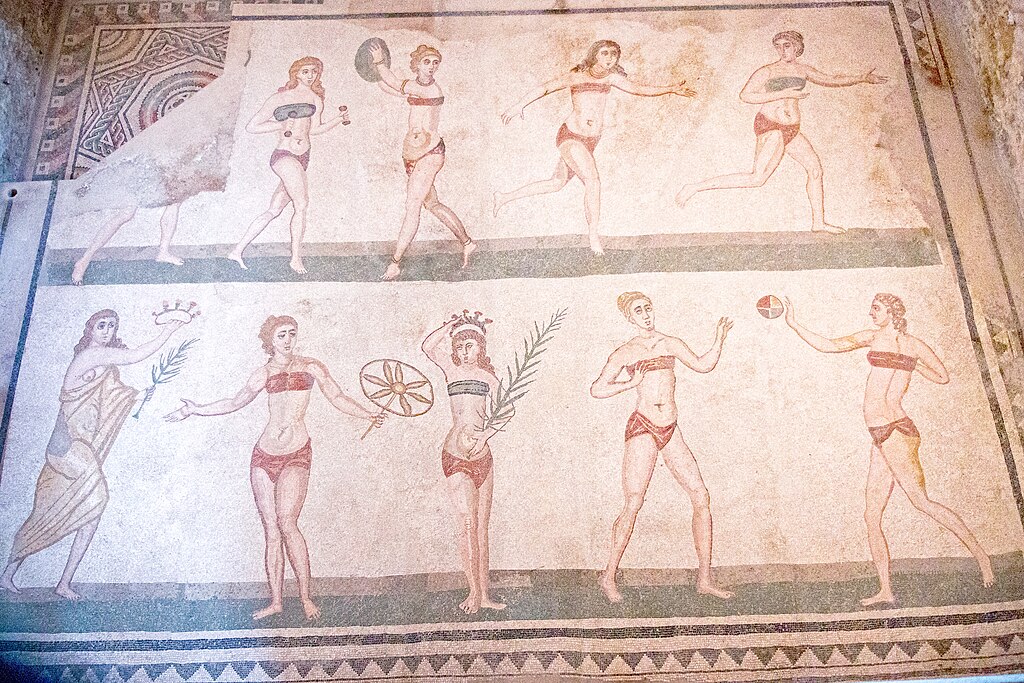
The Villa Romana del Casale is one of the most lavish and best-preserved Roman villas ever discovered, known above all for its mosaics, more than 40,000 square feet of them. The newly uncovered sandals mosaic now joins famous works already found at the site, including the celebrated “Bikini Girls” mosaic depicting nine women engaging in athletics while wearing bandeau-style tops and bikini-like bottoms.
Another signature piece from the villa is the “Great Hunt,” a sprawling mosaic showing exotic animals being captured and loaded onto ships. The sheer artistic variety has long made the villa a centerpiece of Roman art history.
Remarkably, this extraordinary collection survived the centuries thanks to disaster. An ancient flood buried the villa under layers of mud, sealing its floors in protective sediment until modern excavations began.
“No other Roman villa offers such a continuous, intact visual record of elite life in the late empire,” archaeologists at the site have noted in past reports, and each new season of research continues to expand that record.
The sandals mosaic, while smaller in scale, contributes to the broader understanding of how different rooms at the villa were used and decorated. Its placement within the bath complex is especially significant, given that footwear like sandals held symbolic and practical importance in these spaces.
Why Sandal Mosaics Appear So Frequently in Ancient Roman Baths
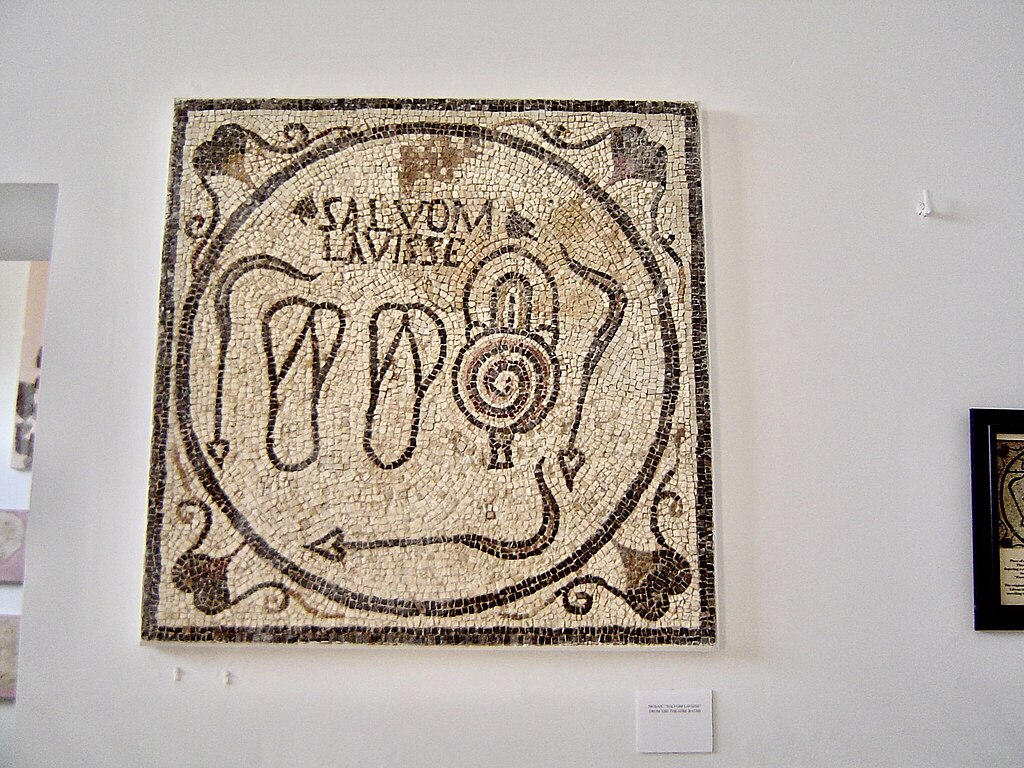
Although this particular mosaic generated excitement due to how modern the sandals appear, similar images have been found throughout the Roman world, especially in bathhouses. The reason is partly practical: just as modern people wear flip-flops in public showers or gym lockers, ancient Romans wore light, slip-on sandals when moving through communal bath complexes.
These images therefore served as decorative cues as well as gentle reminders tied to hygiene and ritual.
Other examples include:
- Timgad, Algeria: A mosaic showing a pair of sandals accompanied by the inscription bene lava, “wash well.”
- Sabratha Museum, Libya: A mosaic depicting sandals, two strigils (common Roman hygiene tools), and an oil vessel, along with the words Salvom Lavisse, meaning “it is healthy to have bathed.”
These recurring images reveal a shared visual language across the empire’s bathhouses, and the newly discovered Sicilian sandals fit neatly into this artistic and cultural pattern.
How Students Helped Uncover the 1,700-Year-Old Mosaic
The project that revealed the sandals mosaic was part of the ArchLabs Summer School, a field-school initiative coordinated by the Parco Archeologico di Morgantina e Villa Romana del Casale, the University of Bologna, and Italy’s National Research Council (CNR).
The students participated in on-site excavation, documentation, and analysis under professional supervision, and the sandals mosaic represents one of the most notable finds from the 2024 session.
According to the site team, both the sandals and the nearby inscription were components of a larger decorative program, likely produced by a master mosaicist associated with elite architectural projects in the late empire. Their craftsmanship, even in small details, reflects the wealth and status of the villa’s original owners.
Preparing the Mosaic for Public Display and Digital Preservation
Now that the sandals mosaic has been fully identified and mapped, conservators are cleaning and stabilizing the piece so it can eventually join the villa’s permanent exhibitions. The work is delicate: although the mud that once buried the mosaic helped preserve it, removal must be handled with precision to avoid damaging the ancient tiles.
At the same time, researchers are compiling all newly collected data into a comprehensive 3D documentation project. This effort will create a digital record of the villa’s architecture, spatial layout, and individual artworks, allowing scholars to analyze the site in unprecedented detail.
The long-term goal is to integrate the sandals mosaic and other recent finds into a unified digital reconstruction of the villa. This will help archaeologists trace artistic patterns, craft techniques, and the architectural evolution of the complex across centuries.
A Glimpse Into Everyday Life In a Luxurious Roman Setting
Although the sandals mosaic may appear simple at first glance, its significance is far greater. It offers a direct, visual link to the daily routines of people who lived 1,700 years ago, how they moved through the bathhouse, what objects they used, and the artistic symbols they encountered in ordinary spaces.
In the context of the Villa Romana del Casale, one of the most extravagant private residences in the Roman world, even a modest image of flip-flops becomes a valuable historical clue. It shows how practical life and artistic expression blended seamlessly in elite Roman environments, producing decorative patterns that still resonate with modern viewers.
With each new discovery at the villa, the mosaic floors continue to reveal stories that remained hidden beneath the soil for centuries, and the sandals mosaic is now part of that rich visual archive.
Featured Image from: bradhostetler, CC BY 2.0, via Wikimedia Commons